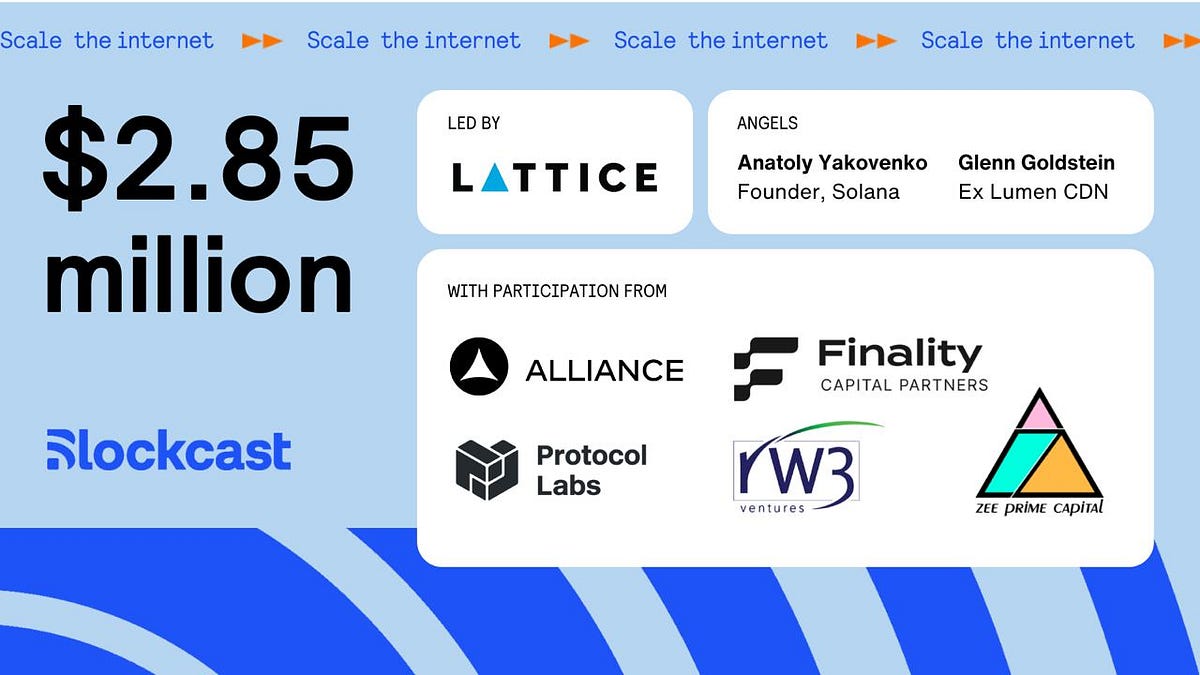
We are excited to announce that Blockcast has raised $2.85M led by Lattice Fund. The round also included participation from Protocol Labs, Finality Capital Partners, AllianceDAO, Zee Prime Capital, RW3 Ventures, and angel investors such as Anatoly Yakovenko, founder of Solana.
Content delivery networks power much of the modern internet, yet the industry remains concentrated among a relatively small number of providers. Blockcast believes a decentralized approach can unlock new capacity, improve performance in underserved regions, and create opportunities for communities, ISPs, and infrastructure operators to participate directly in content delivery. With new funding and growing industry support, Blockcast is building a next-generation CDN platform that combines DePIN principles, multicast technology, and federated delivery networks to expand the reach and efficiency of internet content distribution.
We are excited to announce that Blockcast has raised $2.85M led by Lattice Fund. The round also included participation from Protocol Labs, Finality Capital Partners, AllianceDAO, Zee Prime Capital, RW3 Ventures, and angel investors such as Anatoly Yakovenko, founder of Solana.
Content delivery networks (CDN) are the backbone of internet infrastructure. Without the capacity provided by these massive global networks, the internet we know and love today, the internet that gives us streaming video and game downloads and immersive experiences, wouldn’t really be possible. That makes content delivery a core infrastructure.
However, a handful of companies control this infrastructure for scaling content delivery over the Internet — many of whom it's not their primary business and are limited to where they can build out points of presence (PoPs). This creates an operational and financial bottleneck—users in remote areas serviced by smaller ISPs might get a far less desirable experience when accessing media online. Even in urban areas, ISPs are constantly strained by record-setting audiences demanding higher bitrate content and major content and game releases that can choke up their network. With the metaverse, VR, and XR touted as the next big thing, content services can’t deliver live streams at 4K. More than ever before, network operators and content providers are looking for ways to increase capacity to serve more users with the high-quality experience they expect.
We believe that infrastructure crucial to our everyday lives, like cellular, ISP, and content delivery networks, shouldn’t be controlled by just a few companies. Thankfully, the growth of DePIN projects like Helium and Dawn Internet have shown that these centralized services can be decentralized by enabling everyday users to participate in building that infrastructure using token rewards. Doing so allows everyday people to help extend infrastructure, often into underserved geographies where centralized operators can’t do so profitably. However, with content delivery specifically, all of the users helping to deliver content to their communities are also increasing the internet's capacity, ensuring that more and higher quality content can be consumed at lower cost.
Blockcast’s mission is to empower anyone to access enriching media experiences anywhere in the world. We achieve our mission by enabling the decentralization of CDN while increasing the overall available capacity through user-installed infrastructure and more efficient delivery methods like multicast.
So far, we’ve manifested our mission through:
“The internet’s current infrastructure is struggling to meet the insatiable demand for high-fidelity content. Blockcast’s innovative approach of using community-operated nodes offers an exciting & practical solution. We believe Blockcast will play a critical role in reshaping how data is distributed and consumed, and we are thrilled to be backing them.”
- Mike Zajko, Partner at Lattice Fund
This is just the beginning. We plan to continue advancing our mission by:
Thanks for all your support so far! If you’re excited about what we’re building at Blockcast and want to work with us, we’d love to hear from you on our careers page!
Blockcast is a decentralized content delivery network (CDN) project that aims to increase internet content delivery capacity by enabling community-operated infrastructure. Rather than relying solely on a handful of centralized CDN providers, Blockcast allows individuals, ISPs, and organizations to participate in content delivery, helping improve performance, expand coverage, and reduce bottlenecks in underserved regions.
Today, much of the world’s content delivery infrastructure is controlled by a relatively small number of providers. Blockcast believes this creates limitations in geographic reach, scalability, and cost efficiency. By leveraging community-operated nodes and token incentives, the network can expand into areas where traditional CDN operators may not find it economically viable to deploy infrastructure, while simultaneously increasing overall delivery capacity.
Blockcast uses several types of nodes to support content delivery. RECEIVER nodes help cache content and receive multicast streams, CAST nodes provide mid-tier caching and multicast distribution capabilities, and RELAY nodes act as public edge caches that extend network coverage. Together, these components create a distributed delivery network designed to improve streaming quality, download performance, and overall network efficiency.
Multicast allows a single stream of data to be distributed to many recipients simultaneously rather than sending separate copies to each user. Blockcast incorporates technologies such as its Multicast Adaptive HTTP Proxy and Automatic Multicast Tunneling (AMT) to make multicast more accessible across existing internet infrastructure. This can reduce bandwidth consumption and improve scalability for high-demand content distribution.
Following its $2.85 million funding round, Blockcast plans to expand its network by launching community-operated points of presence (PoPs), conducting public beta programs with content partners, developing decentralized node quality verification systems, creating a test network for CDN service contracts, and ultimately launching a main network that enables CDNs to interconnect and exchange capacity through the Blockcast ecosystem.

.png)